Contributed article
Most sustainability consultancies in the UAE arrived by way of compliance, carbon accounting, reporting frameworks, regulatory readiness. Sustainable Narrative arrived from design.
Founded by Najia Qazi, the practice began with a narrow question about the design industry and ended up with a broader one about business models. The gap she set out to fill sat inside a single industry. It did not stay there.
The shift from product to system
The move to full business consultancy was not a pivot so much as a following of the thread. Questioning a garment leads to questioning its materials; questioning materials leads to the supply chain; and questioning the supply chain leads, eventually, to the business model that sits behind all of it.
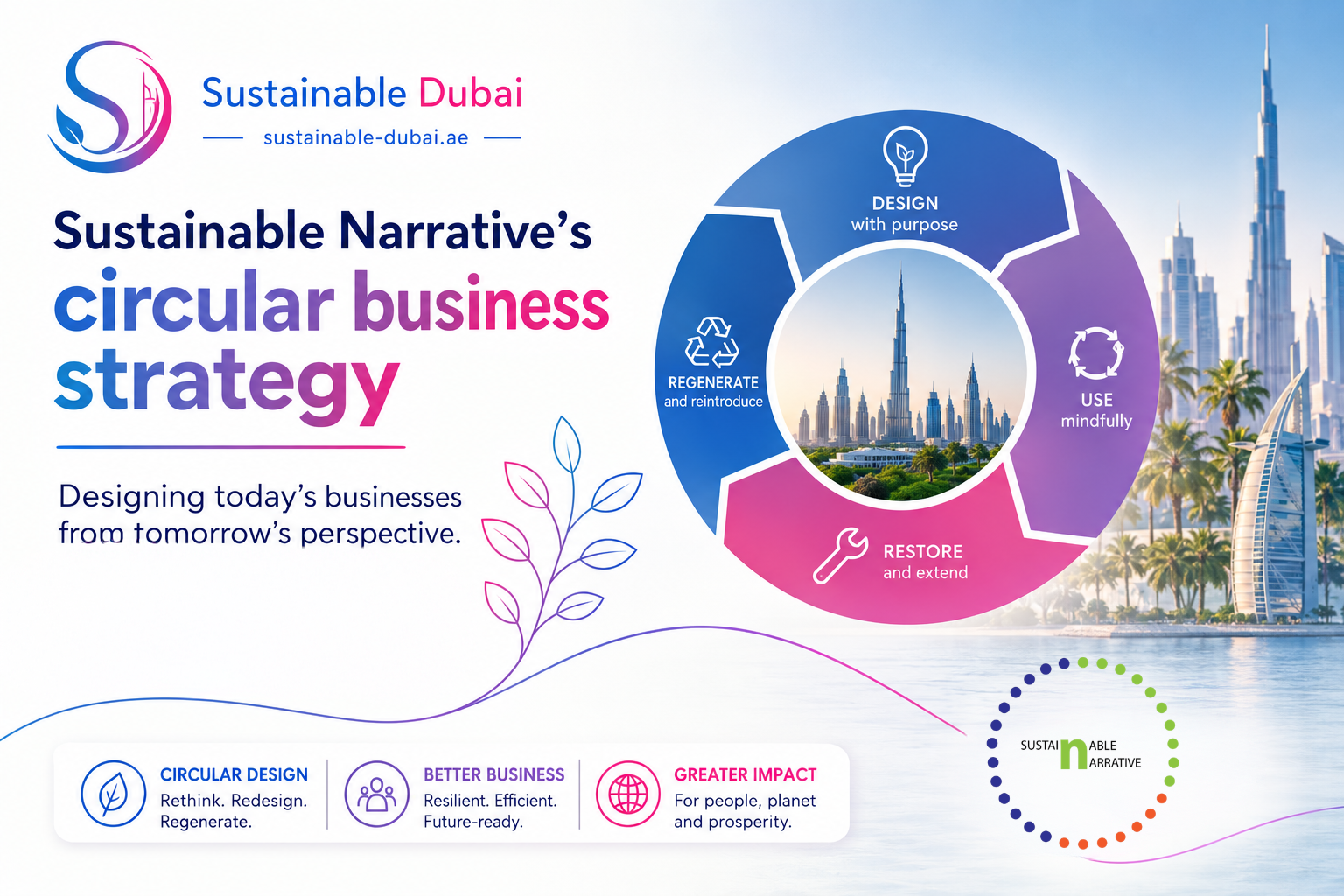
That progression explains the practice’s central idea, which it calls circular design theory. Conventional industry runs on linear logic: take, make, discard. Circular design starts further upstream, at the point where a product or service is conceived, and asks whether it can be built to be restored, renewed, or reused rather than replaced. A garment designed this way might use mono-materials that can be recycled without separation, or modular components that can be repaired rather than thrown out; a piece of furniture might be designed for disassembly so its parts can re-enter the supply chain at the end of its life.
Applied to a business rather than a product, that means examining material selection, resource efficiency, energy use, and the systems through which value is created. Sustainable Narrative works with clients on incorporating these principles alongside the UN Sustainable Development Goals into long-term strategy, rather than treating sustainability as a separate workstream running parallel to the real business.
The practice’s own formulation for this is business today, seen from the perspective of tomorrow.
“My aim at Sustainable Narrative is to advocate for sustainability as a necessary choice rather than a corrective action, striving to fully integrate sustainable practices into everyday life.”
Najia Qazi, founder, Sustainable Narrative
Who it works with
Sustainable Narrative’s client base sits largely among startups, incubators, and design-led businesses in the UAE, organisations at a stage where sustainability decisions are still architectural rather than retrofitted.
This is a meaningful distinction. Advising an established manufacturer to become circular means asking it to unpick decisions made years ago, renegotiating supplier contracts, retooling production lines, reworking packaging that’s already been signed off. Advising a business still designing its model means the same principles cost far less to adopt. The earlier the intervention, the cheaper the circularity.
Alongside client work, the practice operates as an advocacy platform, publishing research and commentary around circular economy ideas. Qazi has spoken on the subject across UAE and international forums and has served as a judge on sustainability initiatives in the region.
The range of the work
The organisations Sustainable Narrative lists among its collaborations give a sense of how widely that approach has travelled. They include UAE government and quasi-government bodies, the Ministry of Climate Change and Environment, the Dubai Supreme Council of Energy, DEWA, Dubai Tourism, and the World Green Economy Organization, alongside major events including Expo 2020 Dubai, COP28, and the Gulf Sustainability Awards.
A second cluster reflects the practice’s work with educational institutions. A third is commercial: Al-Futtaim, the L’Oréal Group, and a set of smaller UAE ventures.
It is a wide span for a small practice, and it says something about where circular design thinking currently sits in the UAE: not yet embedded in any one sector, but wanted in most of them.
Why it matters here
The UAE’s sustainability infrastructure has matured quickly at the top of the market. Large corporates, listed companies, and government-linked entities now have reporting obligations, dedicated teams, and consulting budgets to match. The layer beneath them, startups, small design practices, independent studios has far less support, and is where a disproportionate share of the country’s new business formation happens.
A consultancy that speaks the language of design rather than the language of audit has a particular use in that layer. For a founder building a product, “circular design” is a more legible instruction than “Scope 3 emissions.” It describes something they can act on at the drawing board. A founder can ask “can this be taken apart and remade?” while sketching a prototype; asking “what’s our Scope 3 exposure?” only makes sense once the product already exists.
Underlying all of this is Sustainable Narrative’s central argument: ethical, sustainable, and profitable are not competing objectives. That claim is now common enough to be unremarkable. What is less common is a practice that starts from how things are made, and works outward from there.
At a Glance
Sustainable Narrative
Registered as an LLC in Dubai, 2023 · United Arab Emirates
Founder: Najia Qazi
Sector: Circular economy, consultancy and advocacy
Web: sustainablenarrative.net