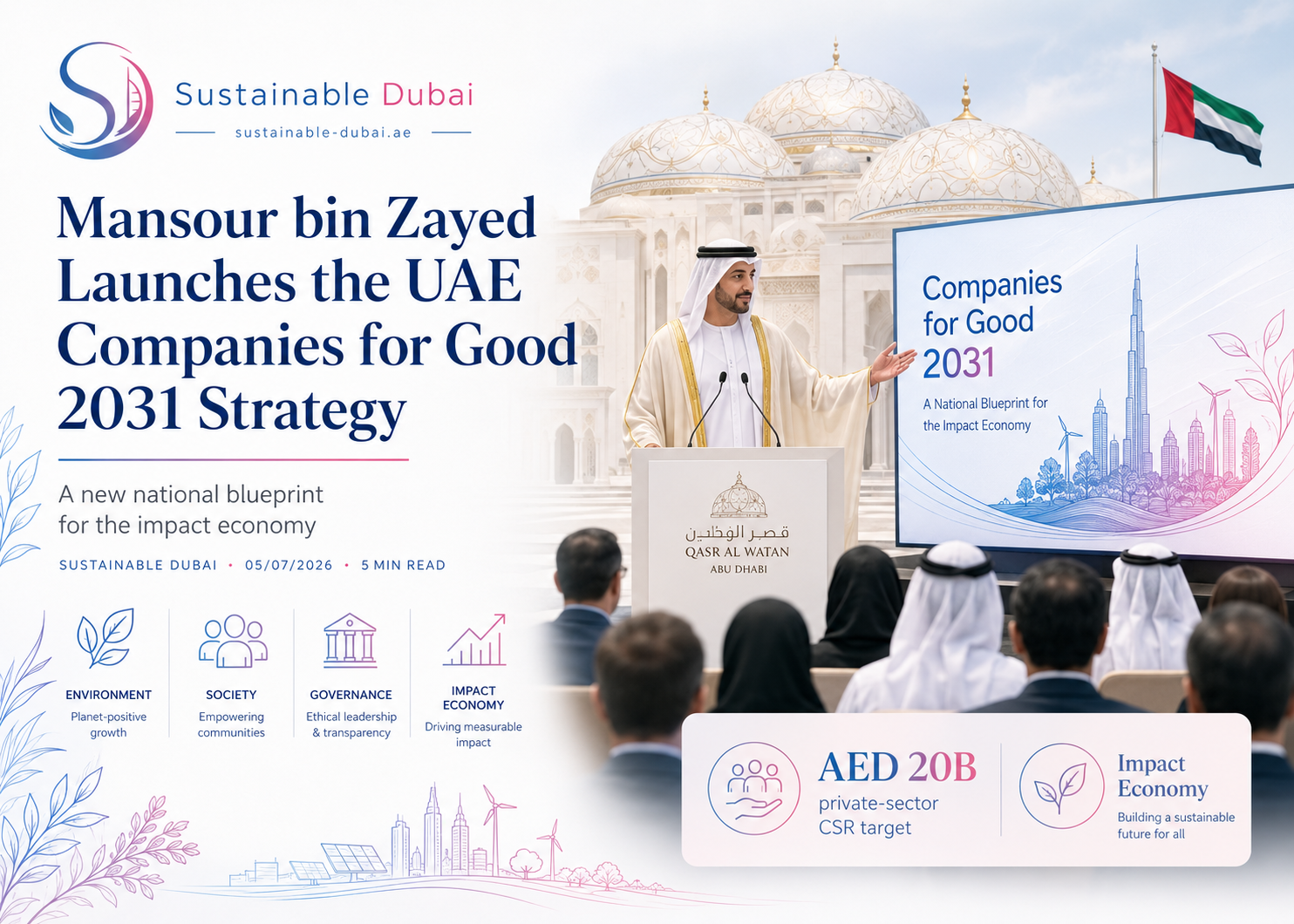
The UAE has just given corporate sustainability its most ambitious national framework yet. His Highness Sheikh Mansour bin Zayed Al Nahyan, Vice President, Deputy Prime Minister and Chairman of the Presidential Court, has launched the UAE Companies for Good 2031 Strategy (استراتيجية شركات الإمارات أجل 2031), a comprehensive plan to turn the private sector into a driving force for measurable, sustainable impact across the country.
The strategy was unveiled at Qasr Al Watan in Abu Dhabi during an event organised by Majra, the National CSR Fund, held on the sidelines of the Cabinet Committee for Artificial Intelligence and Digital Economy. For readers who have followed our coverage of Majra’s Sustainable Impact Challenge, this is the bigger picture that work sits inside: a nationwide push to make responsible business the norm rather than the exception.
What the strategy sets out to do
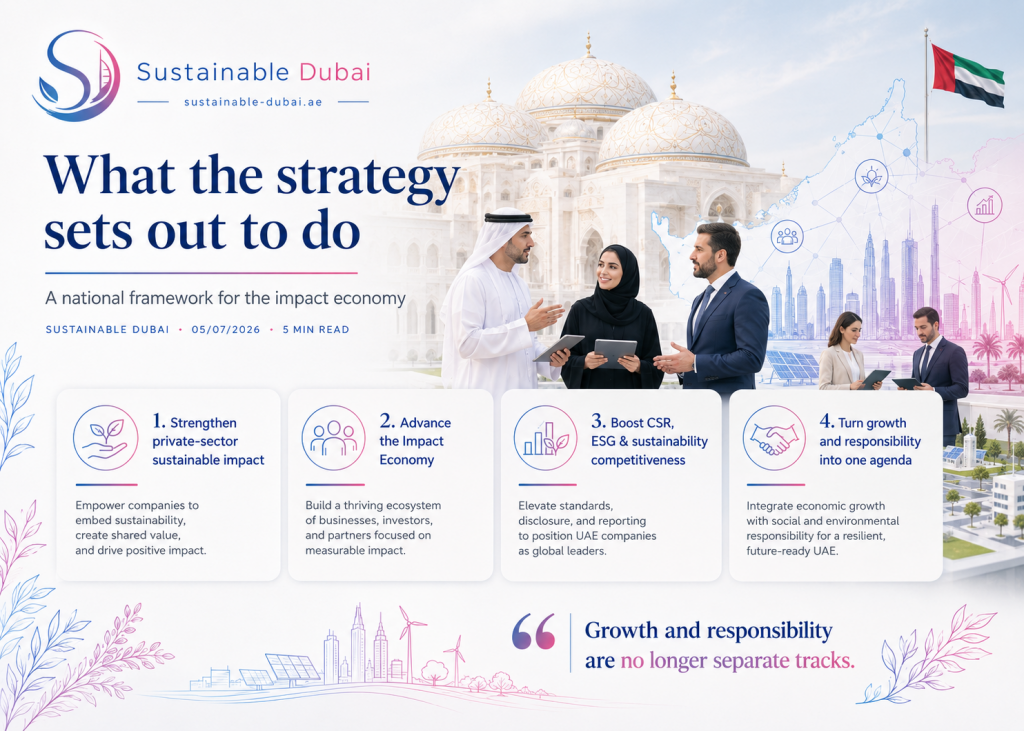
At its heart, the Companies for Good 2031 Strategy establishes a national framework to strengthen private-sector contributions to sustainable impact, advance what the UAE calls the Impact Economy, and sharpen the competitiveness of the country’s corporate social responsibility (CSR), ESG and sustainability ecosystem.
Sheikh Mansour framed CSR and sustainable impact as fundamental pillars of the UAE leadership’s vision for the prosperity of people and society, noting that the role of companies now extends well beyond economic growth to delivering impact that improves quality of life and supports the sustainability of both society and the environment.
In other words, the message to business is clear: growth and responsibility are no longer separate tracks. They’re meant to run together.
The numbers behind the ambition
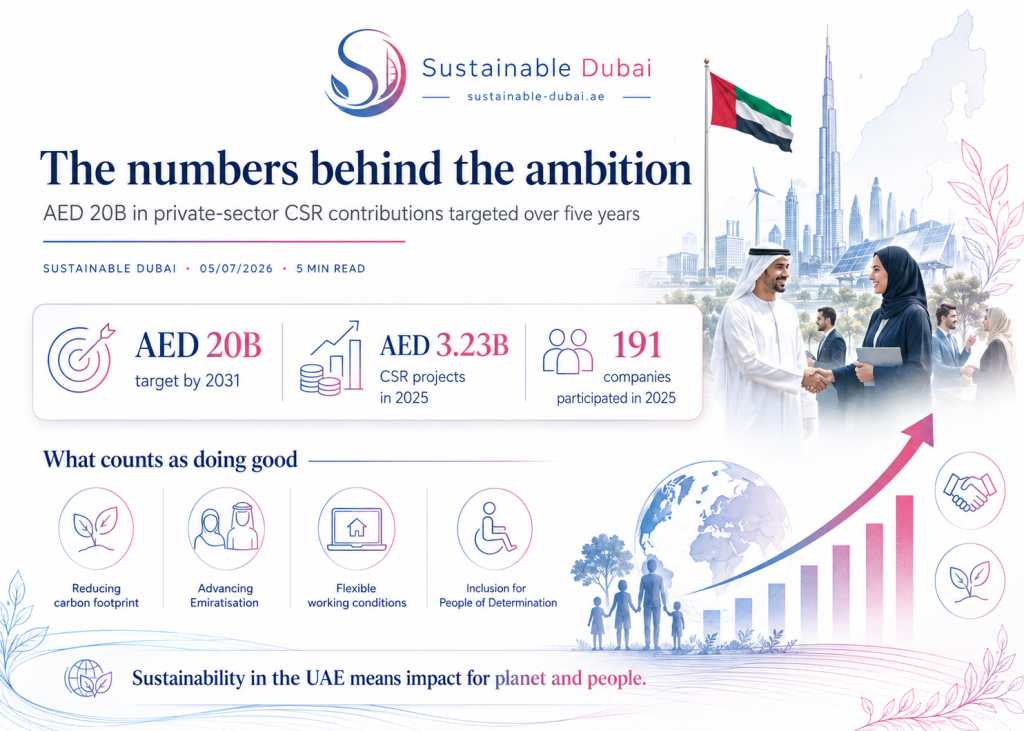
The scale of the target is striking. Through the strategy, the UAE aims to attract more than AED 20 billion in private-sector CSR contributions over the next five years.
That builds on real momentum. In 2025, the country’s private sector delivered CSR projects worth AED 3.23 billion, with 191 companies taking part. The 2031 strategy is designed to multiply that participation and channel it toward national priorities, giving companies a structured way to measure, report and scale their contributions rather than treating good works as one-off gestures.
What counts as “doing good”
One of the most practical aspects of the strategy is how broadly it defines meaningful contribution. According to Majra, participating companies will share examples of their sustainable policies, and qualifying activities span a wide range, including reducing a company’s carbon footprint, advancing Emiratisation, offering flexible working conditions, and supporting inclusion for People of Determination.
That breadth matters. It signals that sustainability, in the UAE’s vision, isn’t only about emissions or recycling. It’s about how a company treats the planet and its people together, environmental responsibility and social responsibility as two halves of the same commitment.
Honouring the front-runners: the Impact Seal
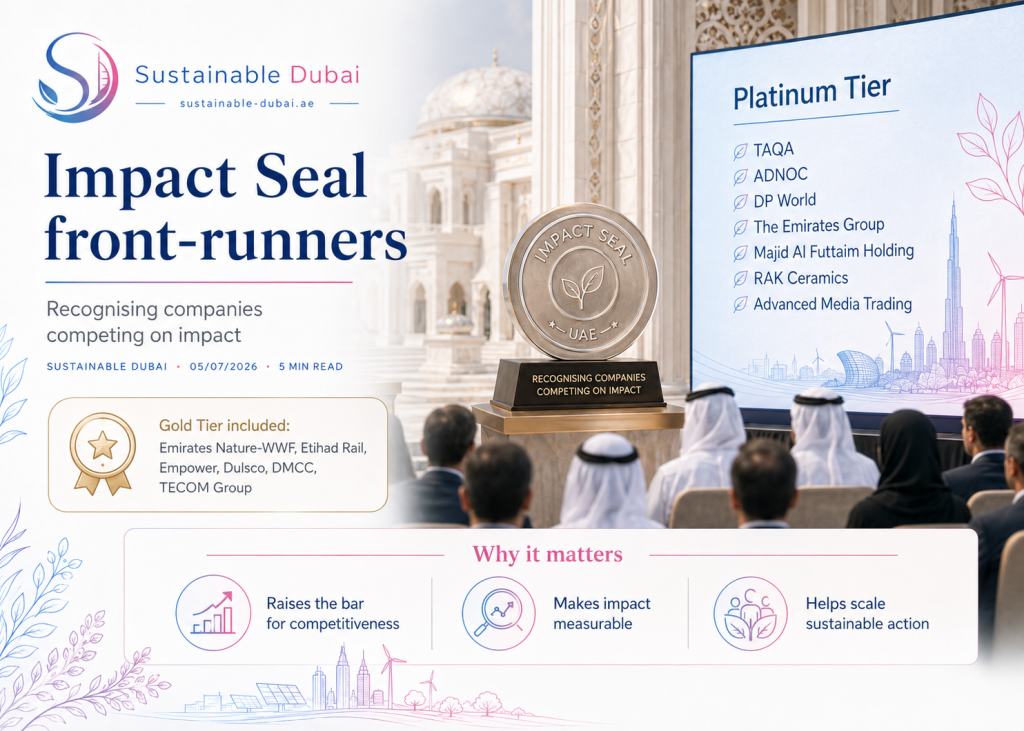
The launch also celebrated companies already leading the way. Sheikh Mansour honoured the winners of the Impact Seal Platinum Tier, Majra’s recognition for organisations demonstrating exceptional sustainable impact. This top tier included TAQA, ADNOC, DP World, The Emirates Group, Majid Al Futtaim Holding, RAK Ceramics and Advanced Media Trading.
Dozens more earned Gold Tier recognition, among them names with strong sustainability track records such as Emirates Nature-WWF, Etihad Rail, Empower, Dulsco, DMCC and TECOM Group, alongside major banks, energy firms and corporates. Together, the honour roll reads like a cross-section of the UAE economy choosing to compete on impact, not just profit.
The Impact Seal for the 2025–2027 cycle drew 160 applications, with 114 organisations recognised across the Platinum, Gold and Silver tiers. And it’s in the Silver Tier that this story comes home for us. That tier includes WAT (We Are Tech), the e-waste innovator we profiled in our Green Innovators series, alongside HeroGo, the food-rescue platform we’ve followed through Majra’s Sustainable Impact Challenge, and RBT Collective, one of the six companies that received the UAE’s first Green Licence at Expo City Dubai just this week. The tier also recognised other green names such as Neutral Fuels, Tadweer, and Jane Goodall’s Roots & Shoots. Seeing homegrown sustainability ventures we’ve championed earn national recognition is exactly the kind of progress this strategy is built to accelerate.
Sarah Shaw, Chief Executive of Majra, described the launch as a significant milestone in the UAE’s journey to strengthen its sustainable impact ecosystem, giving the private sector a national framework to maximise its contribution while advancing the impact economy.
Why it matters
For anyone invested in the UAE’s green future, this is a big deal. National sustainability targets like Net Zero 2050 can’t be met by government action alone; they need thousands of companies pulling in the same direction. A strategy that puts a number on private-sector contribution, AED 20 billion, and a system for measuring it turns broad ambition into something accountable.
It also raises the floor for everyone. When the country’s largest corporates are publicly recognised for impact, and when a clear framework exists for others to follow, sustainability shifts from a nice-to-have into a mark of competitiveness.
The Sustainable Dubai view
We’ve spotlighted the innovators turning sustainability ideas into measurable results, from Green Licence recipients at Expo City to the startups competing in Majra’s Sustainable Impact Challenge. The Companies for Good 2031 Strategy is the national scaffolding that gives all of that momentum a home.
It tells every business in the country, from listed giants to homegrown startups, that contributing to society and protecting the environment is now central to what it means to succeed here. That’s a future worth building toward, and one we’ll keep following closely.
Sustainable Dubai champions the people and companies building a greener UAE. Follow us for more on the innovators shaping the country’s sustainable future.